
Blood vessels
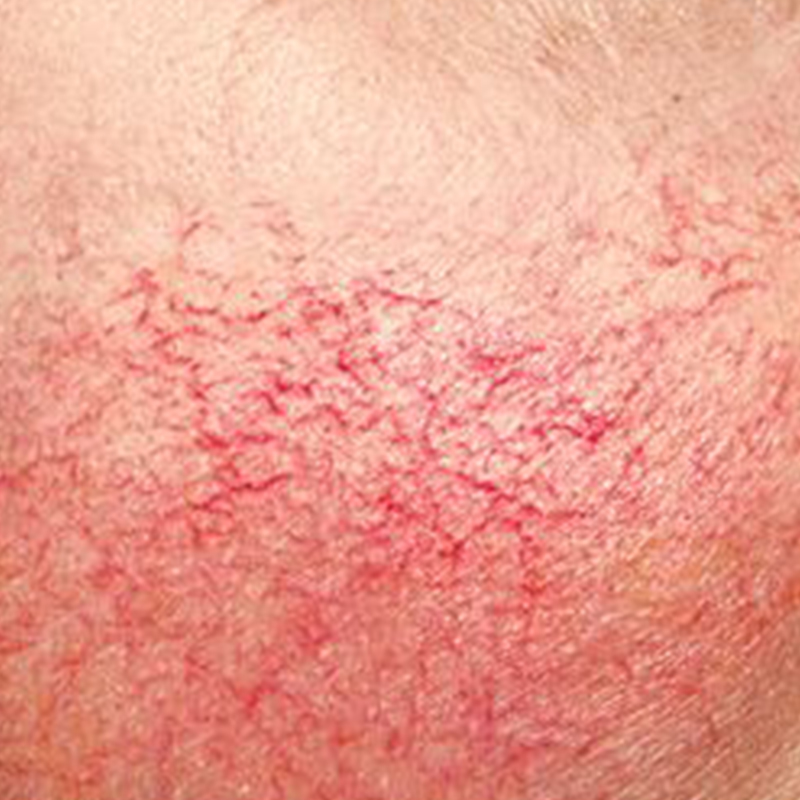
Fine red blood vessels around the nose, on the cheeks or chin can become increasingly visible. Sometimes it’s one noticeable vessel, sometimes a network of small red or bluish-red vessels develops.
Our approach to visible blood vessels
Although visible blood vessels are usually harmless, they can make your skin look constantly red or uneven.
At Huidkliniek Parkstad we first look at the type of vessel, its location and your overall skin picture. Because not all redness is the same, and not every visible blood vessel calls for the same approach.
What are visible blood vessels?
The skin contains an extensive network of small blood vessels. When superficial vessels become dilated and remain visible, they can show through the skin as fine red, pink, purple or bluish-red lines.
In the face, we often see these vessels around the nose, on the cheeks and chin.
When several dilated superficial vessels are present, we often speak of couperose. Visible blood vessels can also occur in skin with rosacea. That is why it is important not just to look at the individual vessel, but at the complete skin picture.
Frequently asked questions about visible blood vessels
Various factors can be involved. With couperose, hereditary predisposition, skin type, sun exposure and temperature fluctuations, among other things, play a role.
In the face, we mainly see them around the nose, on the cheeks and chin. However, vessels can also become visible on other parts of the face or body.
Once superficial vessels are permanently dilated and visible, they usually don’t disappear on their own.
Various superficial vascular structures can be treated with laser technology. Whether your blood vessels are suitable for this depends on factors such as the type of vessel, its colour, location and the surrounding skin.
Not quite. A single visible blood vessel can occur on its own. With couperose there are usually several dilated superficial vessels, which can make an area of the skin look redder.
No. With rosacea, redness can go together with visible blood vessels, but also with other symptoms such as bumps and pimples. That is why, during the assessment, we distinguish between visible blood vessels, couperose and rosacea.
More about causes, types and recognition
Causes of visible blood vessels
Why blood vessels become more visible in one person than in another varies.
Hereditary predisposition can play a role. Skin type, prolonged exposure to sunlight and temperature fluctuations are also factors that can influence visible blood vessels and couperose.
That is why, during an intake, we look not only at the vessel itself, but also at the condition and sensitivity of the surrounding skin.
Different types of blood vessels
Vascular problems can look different: fine red vessels around the nose, red or bluish-red vessels on the cheeks, several superficial vessels with couperose, small red vascular spots, diffuse redness with visible vascular structures and small visible vessels on the body.
Not every vascular structure has the same characteristics. That is important for determining the right treatment.
How do you recognise visible blood vessels?
You can usually recognise visible blood vessels by fine red, pink or bluish-red lines that remain visible through the skin.
With temporary flushing, the redness disappears again. A dilated superficial vessel, on the other hand, remains visible.
When many small vessels lie close together, the skin can mainly look red from a distance. Up close, individual vascular structures can then be recognised.
Example of a result
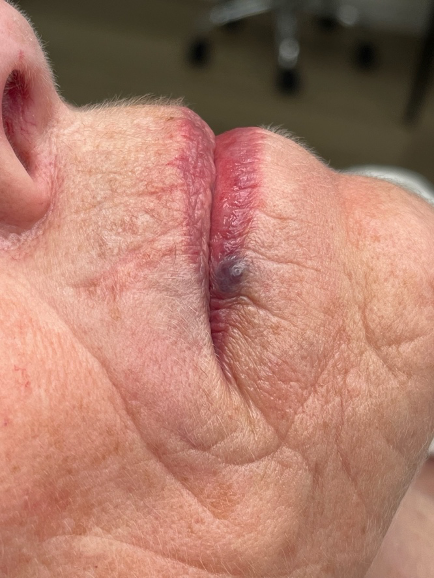 Before
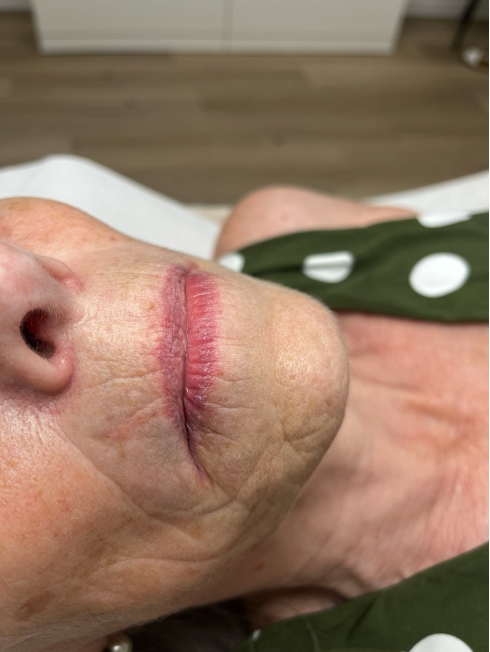 After
What our clients say



Curious about what’s possible for your skin?
Start with an intake. Then we can see what type of blood vessel it is and which approach suits it.